
Thailand Launches Airstrikes on Cambodian Border Targets as Ceasefire Crumbles
Credit:
Thailand launched airstrikes on Cambodian military positions early Monday, marking the most serious escalation since July’s deadly clashes and threatening to unravel the fragile U.S.-brokered ceasefire signed just two months ago under President Donald Trump’s oversight.
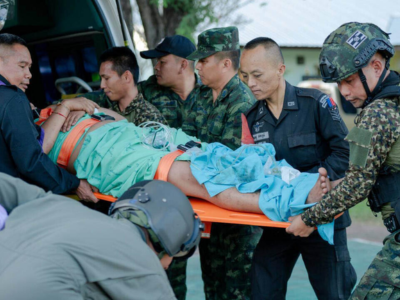
Thai army spokesperson Maj. Gen. Winthai Suvaree reported that Cambodian forces opened fire around 5 a.m. local time in Ubon Ratchathani province, using small arms, mortars, and artillery. In response, Thai F-16 fighter jets struck “military objectives” in Preah Vihear and Oddar Meanchey provinces to suppress fire. One Thai soldier was killed, with eight others wounded.
Cambodia’s defence ministry denied retaliation, accusing Thailand of launching “dawn attacks” near the Preah Vihear temple, a UNESCO World Heritage site at the heart of the century-old border dispute. Officials in Oddar Meanchey reported three civilians injured, while schools along the frontier were shuttered amid panic.
The violence follows a brief skirmish Sunday in Sisaket province that wounded two Thai soldiers. The dispute traces back to colonial-era maps drawn by France in 1907 and a 1962 International Court of Justice ruling awarding Preah Vihear temple to Cambodia, but leaving surrounding territory contested.
July’s five-day war, triggered by a landmine blast, killed 48 people, displaced 300,000, and saw rocket exchanges before Trump’s intervention produced a ceasefire. The October 26 Kuala Lumpur accord, witnessed by Trump and Malaysian PM Anwar Ibrahim, expanded the truce with demilitarization pledges and joint patrols. Yet a November landmine incident that maimed a Thai soldier prompted Bangkok to suspend implementation, accusing Phnom Penh of mine-planting.
Thai Prime Minister Anutin Charnvirakul vowed defensive operations “as necessary,” insisting: “Thailand has never initiated violence but will not tolerate sovereignty violations.” Evacuation orders now cover 385,000 civilians in five Thai provinces, with 35,000 already in shelters. Cambodian residents in Preah Vihear and Oddar Meanchey are also fleeing.
Regional leaders voiced alarm. Malaysia’s Anwar urged “maximum restraint,” warning ASEAN cannot afford cycles of confrontation. Former Cambodian PM Hun Sen appealed for calm, accusing Thailand of baiting retaliation. The U.S. State Department called for de-escalation, crediting Trump’s deal but declining to assign blame.
Analysts warn the conflict carries geopolitical undertones: Thailand remains a U.S. non-NATO ally, while Cambodia is closely aligned with Beijing, complicating mediation efforts.
On social media, Thai users circulated evacuation alerts and footage of explosions, including claims of an F-16 strike on a Cambodian casino allegedly used as a command post. Cambodian accounts amplified denials of retaliation, while observers fear the clashes could fracture ASEAN unity.
As artillery echoes across the frontier, the Trump-brokered truce hangs in the balance. The question now is whether diplomacy can salvage peace—or whether Southeast Asia is sliding back toward July’s carnage.








0 Comment(s)